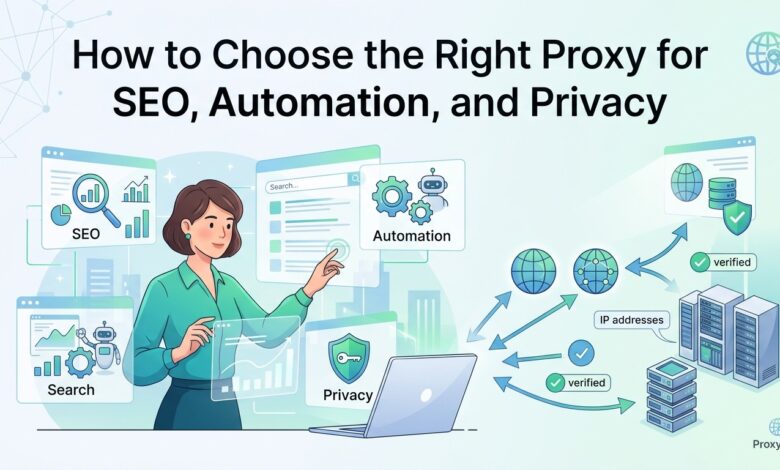
A single wrong IP address can slow your SEO work, break your automation, or expose your real location online. The right proxy does the opposite: it keeps your workflow stable, protects your data, and helps you work across locations without constant blocks.
Before adding any address to your tools, use a trusted proxies checker to confirm that it is active, fast, and suitable for your task. This simple step can save hours of troubleshooting later.
Understanding Proxy Types and Their Main Uses
A proxy server works as a middle layer between your device and the websites you visit. Instead of connecting directly, your request goes through the proxy first. The website sees the proxy IP address, not your personal IP, which helps you manage location, privacy, and access.
There are several common proxy types. HTTP proxies are useful for regular web browsing, scraping, and SEO tools. SOCKS5 proxies are more flexible because they can handle more types of traffic, including some applications and services beyond standard web pages. IPv4 and IPv6 refer to the IP version; IPv4 remains widely compatible, while IPv6 offers a much larger address pool.
Proxies are commonly used for:
- SEO research, keyword collection, and competitor analysis
- Web scraping and data parsing
- Managing multiple social media or advertising accounts
- Accessing region-specific content and services
- Improving privacy when using public networks
- Testing websites from different locations
Private proxies are usually the better choice for business tasks. They are assigned to one user, which reduces the risk of overcrowded connections and unstable performance. Proxyline offers private IPv4 and IPv6 addresses, HTTP and SOCKS5 support, instant activation, and tools for selecting a city, subnet, or IP binding.
What to Look for in a Proxy for SEO Tasks
SEO work often involves repeated searches, keyword research, rank tracking, and competitor monitoring. Doing this from one IP address can trigger captchas, temporary blocks, or inaccurate location-based results. A good proxy helps you spread requests across different IPs and view search results from the locations that matter to your campaign.
When choosing a proxy for SEO, focus on stability first. A proxy that disconnects often can interrupt a scraping job or cause incomplete data. Speed also matters, especially if you process large keyword lists or collect search results regularly. Look for low ping, fast page loading, and consistent response times.
Location control is another important factor. If you need to check rankings in a particular country or city, choose a provider that lets you select the IP location. This helps you see more accurate local search results and avoid misleading data.
Other useful features include:
- Dedicated or private IP addresses
- Support for HTTP and SOCKS5 protocols
- Unlimited traffic or clear traffic limits
- IP rotation or the ability to add and remove IPs
- A simple dashboard or API for managing proxies
- Fast support if an address stops working
For SEO teams, a proxy should feel like dependable infrastructure, not an extra problem to manage. Test each IP before adding it to your tools, especially if you plan to use it for automated requests.
Setting Up Proxies for Automation Without Risks
Automation saves time, but it also increases the chance of detection if it is configured poorly. Whether you run account management software, scraping scripts, ad verification tools, or social media workflows, your proxy setup should look natural and remain stable.
Start by matching one task to one IP where possible. Using the same proxy for unrelated accounts can create unnecessary risk. If you manage several accounts, separate them across different private IPs, especially if the accounts belong to different people, brands, or regions.
Keep request rates reasonable. Even a high-quality proxy cannot protect a workflow that sends too many requests too quickly. Add delays, rotate tasks, and avoid running every action at the same moment. This reduces blocks and makes your automation more reliable.
A safe automation setup usually includes:
- Private IPs instead of shared public proxies
- Separate proxies for separate accounts or projects
- Consistent browser settings, time zones, and language settings
- Controlled request frequency and realistic delays
- Regular proxy testing before important tasks
- Backup IPs in case one address becomes unavailable
Before launching a campaign, check every proxy for validity, protocol, speed, and location. A online proxies checker can show whether an IP is working, identify its country and city, and display its connection speed, ping, and confidentiality level. This small step can prevent wasted time and failed automation jobs.
Protecting Your Online Privacy With Private IPs
Privacy is one of the main reasons people use proxies. A private IP hides your real address from websites, reduces tracking based on your location, and gives you more control over how you appear online. This is useful for everyday browsing, remote work, research, and accessing services while travelling.
However, a proxy is not a complete security solution. It should be combined with safe habits such as strong passwords, two-factor authentication, updated software, and caution with unknown downloads. If you handle logins, payment details, or client data, choose a trusted paid provider rather than a free public proxy.
Free proxies often have too many users on the same address. This can lead to slow speeds, frequent failures, and weak anonymity. Private proxies are generally more reliable because the IP is not shared with a large group of strangers.
When checking privacy, look at:
- The proxy protocol and whether it supports your tools
- The confidentiality or anonymity level
- The IP location and whether it matches your needs
- Connection speed and ping
- Whether the IP is dedicated to you
If you want to see these details before buying, run the address through a proxies checker first. It gives you a quick picture of the IP quality and helps you avoid addresses that are slow, blocked, or unsuitable for private browsing.
Final Thoughts on Selecting the Right Proxy
The right proxy depends on what you need it to do. For SEO, prioritize stable private IPs, location selection, and enough speed for research or scraping. For automation, separate your accounts, control request rates, and keep backup addresses ready. For privacy, choose a dedicated IP from a trusted provider and test it before use.
Avoid choosing a proxy only because it is cheap. A low-cost shared address can cost more in lost time, blocked accounts, and incomplete data. A private proxy with good speed, clear location options, and responsive support is usually the smarter long-term choice.